
Introduction
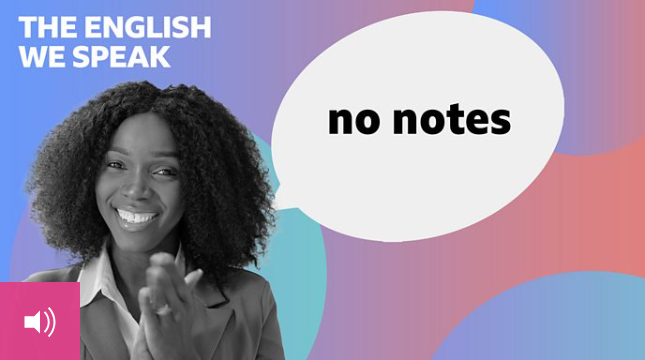
Notes here is about negative feedback, so ‘no notes’ means that something is perfect. Use it when you have nothing negative to say. Learn about this expression with Feifei and Georgie.
Transcript
Feifei
Hello and welcome to The English We Speak, where we explain expressions used by fluent English speakers so that you can use them, too! I’m Feifei, and I’m joined by Georgie. How are you? Have you had a good week so far?
Georgie
I really have. A few days ago, I went to see one of my favourite bands. The singer was incredible and my sister put me on her shoulders for my favourite song. It was unbelievable – no notes. How about you?
Feifei
I’m having a great week too. The weather’s been lovely, I’ve managed to get all my work done on time and I’ve even had time to meet friends after work! No notes.
Georgie
That sounds wonderful, Feifei. I’m so happy for you! Now, let’s learn the expression ‘no notes’.
Feifei
Yes. Use ‘no notes’ when you want to say something is perfect. ‘Notes’ in this context refers to feedback or criticism, just like when a teacher assesses a piece of work and leaves notes for future improvement.
Georgie
Right. So, if you say ‘no notes’, you are expressing that you have no feedback or criticism. Whatever you’re talking about is perfect or flawless.
Feifei
So, you used it in the context of a singer’s performance. I used it when talking about my perfect week. Now, time for some more examples.
Examples
That three-course meal was incredibly delicious. No notes.
I went to a wedding and the best man’s speech was hilarious. No notes.
Wow. Your outfit is stunning. No notes.
Feifei
Georgie, is the expression ‘no notes’ always used on its own, without a verb?
Georgie
Most commonly, it is used on its own, but you might also hear a sentence like ‘I have no notes’.
Feifei
OK, let’s recap. ‘No notes’ is a modern slang expression that is used when something is perfect and no negative feedback is needed.
Georgie
Thank you for joining us. Goodbye!
Feifei
Bye bye!